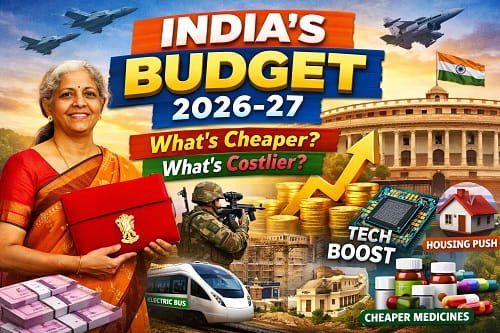
India’s 2026-27 Budget outlines how the government will spend and collect money in the coming year. The total Budget size is set at ₹53.5 lakh crore, showing a modest rise over last year as the government balances fiscal discipline with growth needs.
There’s a continued push on infrastructure, jobs, domestic manufacturing, technology, agriculture and rural support. At the same time, the government is keeping a tight fiscal belt with the fiscal deficit targeted at 4.3% of GDP — a slight improvement from the previous year’s estimate.
Here’s how the Budget stacks up.
Fiscal Health: Numbers You Should Know
- Total Expenditure:₹53.5 lakh crore (up about 7.7% from revised last year).
- Capital Expenditure:₹12.2 lakh crore — an 11.5% increase, signalling focus on infrastructure and assets.
- Fiscal Deficit: Targeted at 3% of GDP, slightly lower than last year’s.
- Borrowing: Record ₹17.2 lakh crore gross borrowing planned, to finance the gap between spending and receipts.
This mix means the government is borrowing more but also trying to build assets and support growth, rather than purely spending on subsidies.
Sector-Wise Allocations and Key Priorities
Here’s how major sectors are treated and what the government is focusing on:
1. Infrastructure: Roads, Railways, High-Speed Growth
One of the loudest themes is infrastructure spending.
- Roads & Rail:These get a big share of capital outlay — roads, rail lines, and seven high-speed rail corridors are in the pipeline.
- Electric Buses:4,000 e-buses will be run across the country to boost clean mobility.
- Freight and Logistics:Dedicated freight corridors and logistics infrastructure are getting support to reduce transit costs.
This is classic long-term nation-building money — wider roads, modern rail connectivity and clean city transport. Big projects tend to take years to pay off, but they lift the whole economy.
2. Defence: Stronger Posture, More Modern Gear
The defence allocation rises to an estimated ₹7.84 lakh crore, about 7–15% more than last year.
- Focus on indigenous production, advanced missiles, drones, submarines, fighter jets and radar systems.
- Capital outlay for Defence Services set at ₹2.19 lakh crore— more than 17% increase.
This reflects shifting global geopolitics and a push to build more equipment inside India instead of importing.
3. Agriculture and Rural Economy
The Budget maintains support to farmers and rural growth:
- Some customs duties on agricultural inputs and fisheries have been cut or rationalized.
- New schemes focus on credit-linked growth, tailored AI tools for agriculture, and reducing risk for farmers.
Food and fertiliser subsidies overall are estimated at around ₹4.5 lakh crore — slightly lower than last year.
4. Education, Skilling and Future Jobs
The Budget has big plans for skills, education and employment pathways:
- A special Education to Employment committeewill focus on job creation in service sectors.
- The Animation, Visual Effects, Gaming and Comics (AVGC) industry gets a push through an India Institute of Creative Technologiesand labs in schools and colleges.
- National Institutes of Design and industry collaboration hubs are set up for talent growth.
Young people entering the job market may get more structured support to match skills with work.
5. Health, Medicines and Wellness
There are significant changes in healthcare focus:
- Cancer drugs and key medical devicesget cheaper or duty-free status — a boost for patients.
- Insurance and wellness schemes continue with more funding though not dramatic increases.
With the rising burden of lifestyle diseases, cheaper essential medicines can ease household costs.
6. Technology and Manufacturing
The Budget leans heavily toward cutting-edge tech and making India a global factory:
- Electronics, semiconductors, rare-earth processing and biotech manufacturing get special attention.
- Cloud services based in India get tax holidays till 2047to attract global players.
- Customs duty simplification to reduce costs on some high-tech imports.
This is part of a strategy to reduce dependency on imports and make India a manufacturing hub.
7. MSMEs and Small Businesses
Small and medium enterprises get a series of supports:
- A dedicated ₹10,000 crore SME development fundto spur medium-sized firms.
- Duties on some small electronics parts removed to make local assembly cheaper.
- Plans to link MSMEs with corporate value chains under Corporate Mitra Scheme(as reported).
This could help cottage industries and small workshops grow and integrate into bigger markets.
8. Urban Development and Housing
A big jump in funds here too:
- Housing and Urban Affairsgets close to ₹85,500 crore — nearly a 50% jump — largely due to increased allocations under PMAY-Urban schemes.
- Women’s hostels and safe spaces in every district are planned.
Affordable housing and urban facilities matter for jobs and living standards.
What Becomes Cheaper or Costlier for You
Here are some direct effects on costs and everyday expenses:
Cheaper
- Cancer drugs and certain medical devices— customs duty removed.
- Home loan interest benefitsand reliefs for taxpayers continue.
- Electric vehicles and certain electronicsbecome less expensive due to duty cuts.
- Foreign travel and education costssee some tax reliefs on TCS.
Costlier or Impacted
- F&O trading taxincreased — traders may pay more.
- Some luxury imports may see slight duty changes as customs policy is simplified.
Big Policy Themes
Here’s the philosophical outlook:
- Growth First:Strong capital spending for roads, rail, tech and manufacturing.
- Inclusive Development:Special schemes for rural women, MSMEs and creative industry talent.
- Fiscal Prudence:Deficit controlled, debt management targeted.
- Make in India 2.0:Tax incentives to attract global cloud and tech firms.
What Experts and Markets Are Saying
Markets reacted with mixed feelings. High borrowings could keep bond yields elevated even as the government tries to keep rates in check.
Some political leaders criticised that state demands were ignored or that jobs haven’t been directly created. Others praised the long-term strategy.
In Plain Words
This Budget is not about immediate freebies. It’s about making the country run faster in future — better roads, more jobs, smarter factories, cheaper medicines, and stronger defence while keeping the budget in check.
It’s a plan written for stability first, growth next — with pockets of relief for citizens and business incentives to spur investment.