India is facing an unusual test of its energy security as geopolitical tensions flare in West Asia. A brewing crisis involving Iran, the United States and Israel has shaken global energy markets and raised questions about India’s oil supply chain. With much of the country’s crude arriving through the Strait of Hormuz — a key global chokepoint — officials are scrambling to respond. But despite the upheaval, New Delhi insists it has enough fuel stocks to weather a short disruption and options to manage longer uncertainty.
Why the Strait of Hormuz Matters
The Strait of Hormuz is one of the most strategic — and vulnerable — passages in global trade. It links the Persian Gulf with the Gulf of Oman and, ultimately, the Arabian Sea. Roughly 20% of the world’s oil passes through this narrow stretch of water every day, making it critical to energy flows from the Gulf to Asia, Europe and beyond.
For India, the stakes are particularly high. Nearly 40–50% of its crude imports normally transit Hormuz, carrying millions of barrels of oil each day. When that route is threatened, global energy markets react — and so does India’s economy.
The current crisis grew out of joint US-Israel military strikes on Iran and Tehran’s forceful counterattacks on Gulf shipping. Iranian forces have targeted tankers and warned that vessels passing through the strait could be set ablaze. These hostile postures have effectively halted or restricted traffic through Hormuz, straining a supply chain that much of India’s economy depends on.
India’s Current Fuel Stock Situation
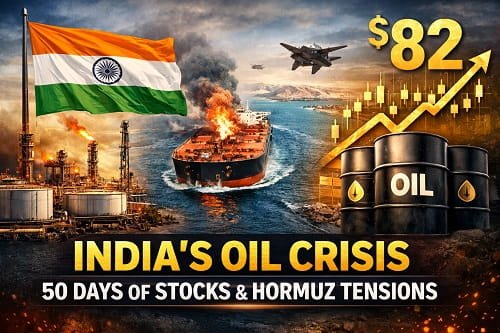
In the face of this disruption, Indian government sources have put a figure on the nation’s cushion: about 50 days of crude oil and refined fuel stocks. This includes crude oil held by refiners and strategic reserves controlled by the government and public sector companies. Officials say this stockpile is enough to meet domestic needs if Hormuz remains blocked for a short period.
To be clear, this doesn’t mean India is free of all risk. About half of these reserves are commercial holdings by refineries and companies, while a smaller portion sits in strategic petroleum reserve facilities. These reserves are designed as emergency buffers, in case of war, disaster or supply shock.
So 50 days of stock sounds comforting, but several factors matter:
- That estimate includes refined products like diesel and petrol, not just crude.
- Strategic reserves are limited in size and take time to refill.
- If the crisis worsens, prices — not just volumes — become a problem for India’s economy.
How India Is Planning for Longer Disruption
Reserve days buy time, not guarantees. New Delhi knows that a serious problem at Hormuz could drag on. So authorities are already talking to industry about alternate oil and fuel sources.
Here’s how government planners are thinking:
- Wider Sourcing Beyond the Middle East
India is actively exploring options for crude, LPG (liquefied petroleum gas) and LNG (liquefied natural gas) from regions outside the Persian Gulf. West Africa, Latin America, the US and other suppliers are on the radar. - Logistics Diversification
Shipping routes that skirt the Middle East — such as around Africa’s Cape of Good Hope — are expensive and slower, but they are alternatives if Hormuz stays closed. This would raise freight costs and pressure domestic prices. - Demand Management
In recent days, some companies have already cut natural gas supplies to industriesin anticipation of tightening LNG imports, especially after production disruption in Qatar. - Contingency Measures with Industry
Government and energy firms are weighing actions such as limiting fuel exports, increasing imports from non-Hormuz sources, and rationing LPG if need be. Such moves would balance supply but affect trade and domestic affordability. - Strategic Partnerships
India’s oil firms have long standing relationships with producers around the world. In times like these, contracts and sourcing flexibility matter. Countries like Russia — already a top crude supplier — could play a bigger role if Middle East flows are disrupted.
Wider Economic and Market Impact
This is not just about crude. More expensive fuel translates into higher transport and manufacturing costs, which then filter through to inflation, corporate earnings and consumer prices. We’ve already seen Indian stock markets dip in reaction to the crisis, as rising oil prices weaken investor sentiment and push up inflation expectations.
Global crude benchmarks have climbed as the crisis worsened. Analysts warn that if fighting continues, Brent crude could spike well beyond current levels, adding to a steeper import bill for India.
Looking Ahead
India’s approach is cautious and multi-layered. Government sources stress that there is no need for panic buying, and that officials are monitoring the situation closely. But risk remains if the Middle East conflict becomes protracted.
The real test will come if shipments through the Strait of Hormuz stay disrupted for weeks or months. That’s when reserves shrink, alternative supply sources get costlier, and the economy feels deeper effects. In the meantime, India is counting on stockpiles, diplomacy, and diversifying its energy portfolio to stay powered and stable.