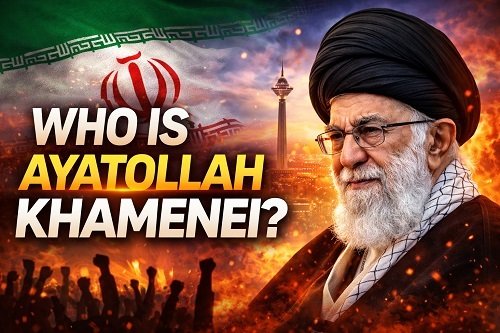
Ayatollah Ali Khamenei was one of the most consequential figures in modern Middle Eastern history. For nearly four decades, he stood at the apex of Iran’s political and religious system as Supreme Leader, exercising authority unmatched by any elected official in the country. His death in late February 2026, during the dramatic escalation of the Israel–Iran conflict involving U.S. strikes, marks the end of an era for the Islamic Republic.
This updated profile covers his early life, rise to power, ideology, rule, controversies, and the circumstances and impact of his death, based on officially reported developments.
Early life and family background
Ali Khamenei was born on July 17, 1939, in Mashhad, a major religious city in northeastern Iran. Mashhad is home to the shrine of Imam Reza, one of the most sacred sites in Shia Islam. Religion shaped his daily life from childhood.
His father, Seyyed Javad Khamenei, was a conservative Shia cleric known for his piety and simple lifestyle. The family lived modestly, often struggling financially. Khamenei later recalled wearing worn clothes and living in cramped conditions, experiences that deeply influenced his worldview and personal discipline.
Religious education and intellectual interests
Khamenei began religious studies at a young age in Mashhad and later moved to Qom, Iran’s most important seminary city. There, he studied:
● Islamic jurisprudence (fiqh)
● Shia theology
● Logic and philosophy
Although he was not initially regarded as a top-ranking religious scholar, he gained recognition as an intellectual cleric. He translated Islamic and revolutionary texts from Arabic into Persian and had a lifelong passion for Persian poetry and literature.
During these years, he was strongly influenced by the ideas of Ruhollah Khomeini, whose teachings fused Shia Islam with political revolution.
Opposition to the Shah
Before the 1979 Islamic Revolution, Iran was ruled by Mohammad Reza Pahlavi, whose regime was supported by Western powers and criticized for repression.
Khamenei joined underground religious networks opposing the Shah. He delivered sermons, circulated banned writings, and helped organize resistance. Because of this, he was:
● Arrested multiple times
● Interrogated and imprisoned
● Sent into internal exile
These experiences established his credentials as a committed revolutionary.
Role in the 1979 Islamic Revolution
When the Islamic Revolution succeeded in 1979, Khamenei quickly rose within the new political system. Though not one of the most visible leaders at first, he gained trust within revolutionary circles and held several important posts.
The new Islamic Republic created a unique system combining elected institutions with clerical oversight — a structure that would later concentrate immense power in his hands.
Assassination attempt and the Iran–Iraq War
In 1981, Khamenei survived a serious assassination attempt when a bomb hidden inside a tape recorder exploded during a public speech. He was gravely injured and permanently lost the use of his right arm.
That same year, Iran was deeply involved in the Iran–Iraq War. Khamenei played a major role in rallying public support for the war and reinforcing revolutionary ideology during one of the most traumatic periods in Iran’s modern history.
Presidency of Iran (1981–1989)
Later in 1981, Khamenei was elected President of Iran, serving two terms. His presidency coincided almost entirely with the Iran–Iraq War and its aftermath.
As president, he focused on:
● Wartime unity
● Ideological consolidation
● Strengthening revolutionary institutions
However, real authority still rested with Ayatollah Khomeini.
Becoming Supreme Leader
When Ruhollah Khomeini died in 1989, Iran faced a leadership crisis. In a move that surprised many, Ali Khamenei was chosen as the new Supreme Leader, despite not holding the highest clerical rank at the time.
Soon after:
● He was elevated to the rank of Ayatollah
● The constitution was revised
● The powers of the Supreme Leader were expanded
This moment marked the beginning of his long and dominant rule.
Power and control
As Supreme Leader, Khamenei wielded control over:
● The armed forces
● The Islamic Revolutionary Guard Corps (IRGC)
● The judiciary
● State television and radio
● Major religious and economic foundations
Presidents and parliaments operated under his supervision. On critical matters — nuclear policy, war, foreign alliances — his word was final.
Ideology and foreign policy
Khamenei’s ideology centered on resistance to Western influence, especially the United States, and unwavering hostility toward Israel. He framed global politics as a struggle between oppressors and the oppressed.
Under his leadership, Iran:
● Expanded its influence across the Middle East
● Supported allied armed groups
● Challenged U.S. and Israeli dominance in the region
Supporters viewed this as standing up to imperialism. Critics saw it as destabilizing and dangerous.
Protests, repression, and criticism
Khamenei’s rule faced repeated domestic unrest, including major protests in 2009, 2019, and 2022. Security forces responded with force, leading to widespread allegations of human rights abuses, censorship, and repression.
To critics, Khamenei symbolized authoritarian rule. To supporters, he represented stability, independence, and resistance.
Death in 2026 and national mourning
In February 2026, amid a rapidly escalating conflict involving Israel, Iran, and the United States, Iranian state media officially announced that Ayatollah Ali Khamenei had been killed in U.S.–Israeli strikes targeting key sites in Tehran.
Following the announcement:
● Iran declared 40 days of official national mourning
● Public ceremonies and state-organized mourning were observed
● Black flags were raised across major cities
● Emergency meetings were held to manage succession and stability
His death marked the most dramatic loss of leadership in Iran since 1989.
Succession and immediate impact
Khamenei’s death created a profound power vacuum. Iran’s Assembly of Experts — the body responsible for selecting the Supreme Leader — moved into emergency session to decide the future leadership of the Islamic Republic.
Internationally, his death intensified regional instability, raising fears of wider conflict and long-term geopolitical shifts across the Middle East.
Legacy and historical significance
Ayatollah Ali Khamenei reshaped Iran more deeply than any leader after the revolution’s founder. He transformed the Supreme Leader’s role into the most powerful position in the country and ensured the survival of the Islamic Republic through war, sanctions, protests, and global pressure.
Whether remembered as a defender of Iranian sovereignty or as an authoritarian ruler, his influence on Iran — and the wider region — will be felt for decades.
His death closes one chapter of Iran’s history and opens another, uncertain and closely watched by the world.