A bizarre and troubling incident from Gurgaon has once again raised questions about social-media stunts, personal security, and the fine line between “content” and criminal behavior.
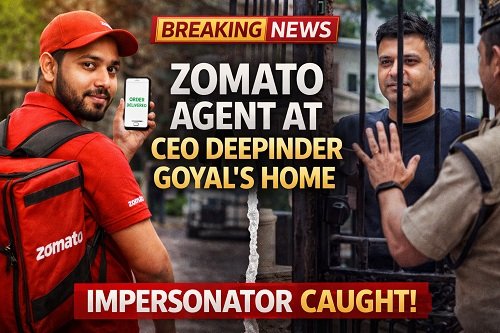
A local content creator allegedly disguised himself as a food delivery executive to gain access to the private residence of Deepinder Goyal, the co-founder and CEO of Zomato. What started as an attempt to create viral content quickly turned into a serious legal matter.
The incident reportedly took place in Gurgaon, a city known for its upscale residential societies and tech professionals.
What Exactly Happened?
According to initial reports, the creator dressed up as a Zomato delivery agent, complete with a branded bag and uniform-style outfit. Using this disguise, he approached Deepinder Goyal’s residence under the pretext of delivering food.
Security personnel at the society allowed him inside, assuming he was just another routine delivery executive. Once near the house, however, the individual began filming and attempting to interact directly with Goyal — all allegedly for social media content.
The act immediately raised alarms. Society security intervened, and the individual was stopped before any further escalation. Police were later informed, and an investigation was launched into how the creator managed to breach residential security so easily.
The Creator’s Claim: “Just Content”
After being questioned, the content creator reportedly claimed he had no harmful intentions. His defense was simple: it was meant to be a prank or “social experiment” video.
But authorities didn’t see it that way.
Impersonating a delivery agent is not harmless fun. It involves misrepresentation and unauthorized access to private property — both serious offenses under Indian law. Officials made it clear that creating online content does not give anyone the right to violate someone else’s privacy or safety.
Legal action is now underway, and the creator may face charges related to impersonation and trespassing.
Why This Incident Is Serious
At first glance, some might see this as just another reckless influencer stunt. But experts say the implications run deeper.
Delivery uniforms are trusted symbols in modern urban life. Thousands of residents allow delivery workers into gated communities every day without question. By exploiting this trust, the creator highlighted a major security loophole.
If someone can walk into a high-profile CEO’s residence pretending to be a delivery agent, what stops someone with genuinely malicious intent?
Security professionals have since warned housing societies to tighten verification processes and avoid granting entry solely based on uniforms or delivery bags.
Zomato Responds
Zomato clarified that the individual was not associated with the company in any way. The brand emphasized that all official delivery partners are verified through in-app tracking and ID systems.
The company also urged residential societies and customers to rely on app-based confirmation rather than visual assumptions.
While Deepinder Goyal has not made a detailed public statement, sources close to the matter say he was unharmed and cooperative with authorities.
The Bigger Problem: Viral Fame at Any Cost
This incident reflects a growing trend where creators chase attention through shock tactics. From public pranks to private invasions, boundaries are increasingly being crossed in the name of engagement.
What’s worrying is how normal such behavior is becoming online.
Experts point out that social platforms reward extreme content with visibility, encouraging creators to take bigger risks. But real life has real consequences — including criminal records.
Law enforcement officials involved in this case stressed that “content creation is not a license to break the law.”
A Wake-Up Call for Residential Security
Beyond influencer culture, the episode has sparked conversations about residential safety in Gurgaon and other metro cities.
Many gated societies depend heavily on guards who face pressure from constant deliveries and visitors. Without stronger verification systems — such as QR scans or resident confirmation — these vulnerabilities remain wide open.
Residents are now being advised to:
- Confirm deliveries via apps before allowing entry
- Avoid blanket access for uniformed visitors
- Push societies to adopt digital visitor management systems
Final Thoughts
What happened at Deepinder Goyal’s residence is more than a headline. It’s a reminder that privacy still matters, security cannot be casual, and internet fame is not worth legal trouble.
For the content creator involved, this “prank” may end up costing far more than it gained.
And for everyone else, it’s a moment to pause and ask — where should the line be drawn between creativity and responsibility?