The gym bra decision gets less attention than it deserves. Most women give considerable thought to the right trainers, the right leggings, the right gym bag — and then reach for whatever sports bra is on top of the drawer without applying the same standard. The result is workouts spent adjusting, readjusting, and tolerating discomfort that accumulates across every session.
The right gym bra for women is not a universal product. It’s a decision that needs to account for the specific activity, the cup size, the fit, and what the body actually requires during sustained physical movement. Getting this right improves every workout — not dramatically, not in ways that show up in performance data, but in the consistent, low-level way that removing constant distraction and discomfort always does.
Why the Gym Bra Decision Matters More Than It Seems
Breast tissue has no muscle. The Cooper’s ligaments — the connective tissue that provides internal breast support — can stretch under the repetitive movement of exercise, and that stretching is cumulative and irreversible. A bra for women that doesn’t provide adequate support during physical activity isn’t simply uncomfortable. It allows movement that, over time and repeated sessions, contributes to permanent loss of natural breast firmness and increased sagging.
This isn’t a reason for alarm — it’s a reason for attention. The right gym bra for women reduces breast movement during exercise to a level appropriate for the activity, which protects the connective tissue while removing the physical discomfort that unsupported movement causes. Both benefits are real and both justify treating the sports bra selection with the same seriousness given to other performance gear.
Impact Level: The Starting Point for Every Decision
Before any other consideration, the impact level of the activity determines the type of support required. Every other decision — style, construction, cup size — follows from this.
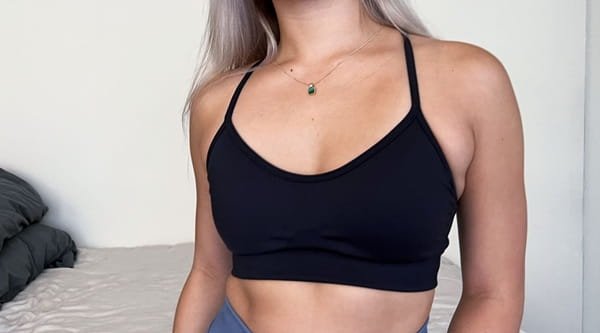
Low-impact activities include yoga, Pilates, stretching, light walking, and barre. These activities involve minimal breast movement, and a lightly supportive gym bra for women is appropriate. Bralette-style sports bras, soft-cup designs, and light compression styles all work well here. The priority is comfort and freedom of movement rather than maximum support.
Medium-impact activities include cycling, hiking, elliptical training, dance classes, and weight training. These involve moderate repetitive movement and require more support than a bralette provides. A medium-support sports bra with a wider band and moderate compression or light encapsulation is appropriate for this range.
High-impact activities include running, HIIT, aerobics, jump training, and any activity involving repeated jumping or rapid directional changes. These require maximum support — specifically, a gym bra for women with encapsulation construction, an underwire or structured cup, a firm band, and wide straps designed to hold the bust securely across sustained high-intensity movement. This is where the difference between the right and wrong bra is felt most immediately and most consistently.
Compression vs Encapsulation: Understanding the Difference
These two construction approaches are the most important technical distinction in sports bra design, and understanding them makes the selection process considerably clearer.
Compression bras hold both breasts together against the chest wall using overall fabric tension. They are simple in construction, often pull-on in design, and work well for smaller cup sizes at any impact level. For larger cup sizes at medium or high impact, compression-only designs tend to flatten rather than support — they reduce movement but don’t manage it in a way that maintains comfort or adequate hold through extended high-intensity activity.
Encapsulation bras support each breast individually in a separate, structured cup — similar to the construction of a regular bra for women but engineered for movement. The cups maintain a defined shape under impact rather than compressing flat, which preserves the natural breast shape and distributes movement more effectively. For women above a C cup, an encapsulation design — or a combination of compression and encapsulation together — is generally the most effective option for medium to high-impact activities.
For fuller busts specifically, an encapsulation gym bra for women with underwire, deep cups, a wide underband, and broad, cushioned straps is the construction standard that provides adequate support for running and other high-impact activities. Compression-only designs, regardless of their general quality, don’t provide the structural hold that larger cup sizes require at high impact.
Fit: Where Most Sports Bras Fall Short
Sports bra fit is less intuitive than everyday bra fit, and the most common mistakes — choosing by clothing size, selecting based on how the bra feels when standing still, or assuming that tighter equals better support — produce garments that don’t perform correctly.
The band of a gym bra for women should fit firmly and sit horizontally across the back without riding up during movement. If the band rides up when arms are raised or during high-impact activity, it’s too loose — and a loose band means the straps are doing support work they shouldn’t be doing, which leads to shoulder strain and inadequate overall hold. Sizing down in the band, or choosing a style with a more substantial band construction, addresses this.
Straps should be snug but not digging in. They shouldn’t slip off the shoulders during movement or dig into the flesh across the top of the shoulders. Racerback and cross-back designs keep straps in place more effectively during high-movement activities than standard parallel straps, which can shift during dynamic exercise.
The cups should fully contain the bust without spillage at the top or sides. A gym bra for women with cups that are too small compresses rather than supports — it may appear to control movement, but the tissue is being pushed out of the cup rather than held within it. This is uncomfortable, visually unflattering, and not structurally supportive.
A reliable fit test: jump in the sports bra before purchasing if possible, or at minimum raise the arms fully overhead and move in the fitting room. A correctly fitted bra for women should feel firm and supportive during movement without requiring any adjustments. If readjustment is needed within the first few minutes, the fit isn’t right.
Material and Construction for Sustained Wear
The fabric of a gym bra for women needs to perform against moisture as well as movement. Sweat-wicking materials — polyester-spandex blends, nylon-spandex blends, and technical mesh fabrics — draw moisture away from the skin and allow it to evaporate rather than saturating the fabric and sitting against the skin. Cotton, while soft, absorbs sweat without releasing it easily — which means it becomes heavy, damp, and uncomfortable during extended workouts and takes considerably longer to dry.
Mesh panels positioned at high-heat zones — across the back, at the underband, and sometimes across the centre front — improve airflow and reduce the heat that builds up during sustained exercise. For women who run hot during workouts or who exercise in warm conditions, ventilation construction in a gym bra is a meaningful comfort factor rather than a minor aesthetic detail.
Flat or bonded seams reduce friction against the skin during repetitive movement. A seam that sits at the underband or along the edge of a cup that rubs with every stride during a long run accumulates into real discomfort by the end of the session. Seamless or minimal-seam construction, particularly at high-contact zones, is worth prioritising in any gym bra for women intended for high-impact or sustained activity.
How Many Sports Bras Are Actually Needed
Rotating between at least two or three sports bras prevents elastic degradation from repeated wear without adequate recovery time. Technical fabrics in sports bras retain their performance characteristics better when washed after each use and allowed to air dry fully before the next wear — which requires having enough in rotation to allow that recovery cycle.
In terms of collection, having one bra for women matched to each impact level — low, medium, and high — covers the majority of training types without over-investing in multiples of the same style. For women who train at high impact most days, two or three high-support options in rotation is a more practical baseline.
The Investment That Pays Off in Every Session
The right gym bra for women is workout equipment in the same sense that quality trainers are. It directly affects physical comfort, protects the body during sustained activity, and removes the low-level distraction of inadequate support that accumulates across every session.
Choosing a gym bra with the specific activity, cup size, and fit requirements in mind — rather than selecting by appearance or defaulting to whatever is available — is the decision that makes the difference between a bra for women that works and one that simply covers.