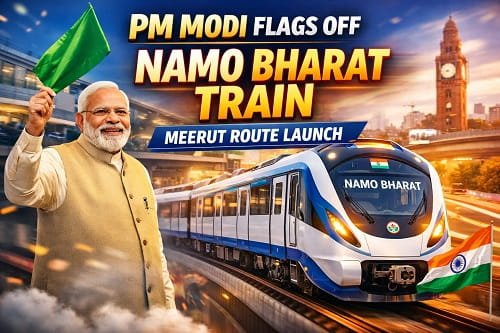
On 22 February 2026, Prime Minister Narendra Modi officially flagged off the Namo Bharat train service and the Meerut Metro in Uttar Pradesh’s Meerut city. The ceremony happened at the Shatabdi Nagar Namo Bharat Station, marking a key milestone in India’s public transport journey.
Along with the rail services, he also dedicated development works worth nearly ₹12,930 crore to the nation — part of a larger effort to boost infrastructure and connectivity in the National Capital Region (NCR).
After the formal inauguration, Mr. Modi boarded the metro and traveled to Meerut South station. A public gathering followed, where officials and citizens witnessed the launch of this ambitious transit project.
What Is the Namo Bharat System?
The Namo Bharat train service is part of India’s first Regional Rapid Transit System (RRTS) — a semi-high-speed regional rail corridor built to link major cities with fast, reliable and efficient trains.
This isn’t just another train line. It’s designed to shrink long, tough road commutes into smooth rail journeys powered by modern technology and high speed. The trains can hit up to 160 km/h, with a design potential of 180 km/h, making them some of the fastest regional services in the country.
These train sets, built and assembled in India by Alstom, feature air-conditioned coaches, comfortable seating, Wi-Fi, CCTV cameras, luggage racks, and other safety systems to make travel secure and convenient.
The Route: Delhi to Meerut
The full Delhi–Ghaziabad–Meerut Namo Bharat corridor spans about 82.15 km. It connects:
● Sarai Kale Khan in Delhi
● Major stops like New Ashok Nagar, Ghaziabad, and Duhai
● Through to Meerut South, Shatabdi Nagar, and ending near Modipuram in Meerut district.
When fully operational, trains on this corridor will cut travel time drastically. What used to take an hour and a half on road can now be done in roughly 55 minutes by train.
The line includes multilevel stations, a mix of elevated and underground sections, and seamless connections with other transport hubs across the NCR — including planned links to Metro and future rapid rail corridors.
Meerut Metro: First of Its Kind
Alongside the Namo Bharat trains, the government inaugurated the Meerut Metro — a city rail service that will operate on the same infrastructure as the RRTS corridor in parts of Meerut. This is a first for India.
The metro covers about 23 km within Meerut, with multiple stations serving local passengers. Because both systems share tracks and facilities, commuters can switch between local metro and regional trains at key stations without changing platforms.
This shared infrastructure helps cut costs and speeds up project delivery while making travel easier for people inside the city and beyond.
Why This Matters
This launch isn’t just about a train line. It’s about rethinking how people move between cities and towns that are economically linked but traditionally separated by slow roads and traffic jams.
Here’s what it means for everyday life:
🕐 Faster Travel
Going from Delhi to Meerut in under an hour will shift how people work, study, and live. More people might choose to live in one city and work in the other without the daily grind of road traffic.
📈 Better Connectivity
The corridor boosts links between Delhi, Ghaziabad, and Meerut — three population and employment hubs. Future expansions could connect other cities too.
🏙️ Economic Growth
Improved transit usually brings investment. Businesses can grow closer to transport nodes, property values can rise, and job opportunities expand beyond old limits.
🌱 Cleaner Travel
Compared with cars and buses, a fast electrified rail system cuts emissions — a big win for urban air quality.
What Comes Next?
This corridor is part of a broader national plan to build multiple regional rapid transit lines across India. As more links open — say from Delhi to Panipat or Alwar — the impact will spread.
For now, the Delhi–Meerut Namo Bharat line stands as a model of high-speed, integrated transit in the region. Daily commuters, students, and families are all expected to benefit when the service settles into regular operations with frequent trains, convenient fares, and better ticketing options.