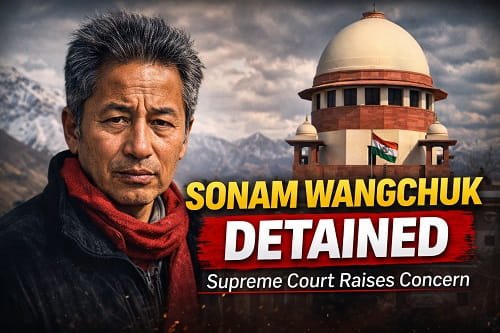
The Supreme Court of India on Tuesday orally asked the Union Government to rethink the continued detention of Ladakhi social activist Sonam Wangchuk, citing concerns over his deteriorating health.
A bench comprising Justice Aravind Kumar and Justice P. B. Varale was hearing a habeas corpus petition filed by Wangchuk’s wife, Dr Gitanjali Angmo. The petition challenges Wangchuk’s detention under the National Security Act (NSA), 1980, calling it illegal and arbitrary.
Wangchuk was taken into custody on September 26 last year and later shifted to Jodhpur following protests in Ladakh that turned violent. The demonstrations were linked to long-standing demands for statehood and stronger constitutional safeguards for the region.
Court Flags Health Risks, Seeks Government’s Response
During the hearing, the bench expressed serious concern about Wangchuk’s physical condition. The judges noted that preventive detention laws must be applied with caution, especially when the detainee’s health is reportedly worsening.
While no formal order was passed at this stage, the court orally advised the Centre to review its decision, stressing that prolonged detention under preventive laws should not become routine.
The bench also sought responses from the Union Government and the Rajasthan administration, where Wangchuk is currently being held, on the legality of the detention and the medical care being provided to him.
Background: Detention After Ladakh Protests
Sonam Wangchuk, widely known for his work in education reform and sustainable development in the Himalayan region, became one of the prominent faces of the Ladakh statehood movement. Protesters have been demanding full statehood for Ladakh along with constitutional protections to preserve local land rights, culture, and employment.
According to official accounts, Wangchuk was detained after protests escalated and authorities claimed his presence could lead to further unrest. He was subsequently booked under the NSA, a preventive law that allows detention without formal charges for extended periods.
However, his family and supporters argue that he was engaged in peaceful advocacy and that invoking the NSA against him amounts to suppressing democratic dissent.
Wife Challenges Detention in Habeas Corpus Plea
In her petition before the Supreme Court, Dr Angmo contended that her husband’s detention violates fundamental rights guaranteed under the Constitution. She argued that there was no immediate threat to public order that justified invoking such an extreme law.
The plea also highlighted Wangchuk’s declining health, stating that he has been on hunger strikes and sustained protests for environmental and regional rights, which have taken a toll on his physical well-being.
The petition seeks his immediate release, or alternatively, a review of the detention order.
Broader Debate on Use of Preventive Detention Laws
The case has reignited debate around the use of preventive detention statutes in India. Legal experts point out that while such laws are meant for exceptional circumstances, they are increasingly being applied in cases involving protests and political dissent.
Human rights groups have also raised concerns, saying that prolonged detention without trial undermines civil liberties and sets a worrying precedent.
The Supreme Court’s remarks on Wangchuk’s health signal judicial discomfort with the continued use of the NSA in this case, though the final outcome will depend on the government’s response and further hearings.
What Happens Next
The Centre is expected to file its reply soon, explaining the grounds for Wangchuk’s detention and addressing the court’s concerns about his medical condition. The Supreme Court is likely to take up the matter again after reviewing these submissions.
For now, the court’s oral observation serves as a strong message: preventive detention must be justified, humane, and proportionate — especially when a citizen’s health is at stake.