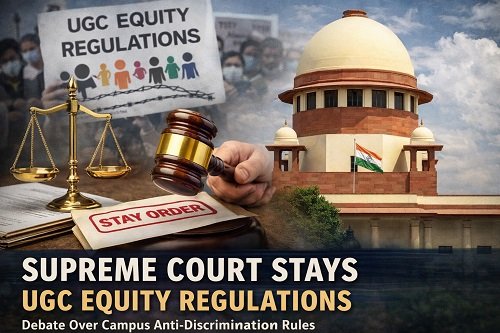
The University Grants Commission’s fresh rules on promoting equity in higher education — notified on January 13, 2026 — aimed to tighten protections against caste-based discrimination on college and university campuses. But within days the regulations ran into mass protests, political pushback and legal challenges. On January 29 the Supreme Court stepped in and kept the 2026 regulations in abeyance, ordering that the older 2012 UGC norms continue to apply until the court hears the petitions. The short order has already sharpened a national debate about free speech, campus safety, legal drafting and how to balance anti-discrimination goals with clear, enforceable rules.
What the 2026 UGC regulations tried to do
The new regulations — formally titled the University Grants Commission (Promotion of Equity in Higher Education Institutions) Regulations, 2026 — were presented as an update to the UGC’s 2012 framework. Their stated goal was to make campuses safer and fairer by defining caste-based discrimination, setting up grievance redress mechanisms and creating institutional offices such as Equal Opportunity Cells and an Ombudsperson to investigate complaints. Supporters said the move was overdue: it modernized procedures and signalled that universities must take bias seriously rather than treating incidents as mere disciplinary matters.
Why so much protest and political heat?
Almost immediately after the rules were notified, protests erupted on many campuses and in public fora. Critics — especially students from the unreserved/general category and some political parties — argued the language used by the UGC created a non-inclusive definition of caste discrimination and could unfairly target or exclude certain groups. Opponents also claimed the rules were vague in important places and could be weaponised in interpersonal or political conflicts inside colleges. That backlash quickly turned the regulations into a political flashpoint, with rallies, petitions and competing public narratives about fairness and protection.
What the Supreme Court actually said in its interim order
A bench led by Chief Justice Surya Kant and Justice Joymalya Bagchi told counsel the regulations were prima facie “vague” and “capable of misuse,” and that the language in key provisions needed re-modification. For now, the court held the 2026 regulations in abeyance and ordered that the UGC Regulations of 2012 remain operational until the petitions are decided. The court also issued notice to the Union government and the UGC with a returnable date — signalling that detailed legal scrutiny will follow.
The legal and policy fault lines
Two major fault lines explain why the court acted quickly.
First, legal clarity: courts demand workable rules. When regulatory text leaves core terms undefined or wide open to interpretation, judges worry that enforcement will be arbitrary. The UGC’s critics persuaded petitioners and the bench that Regulation 3(c) — the provision defining caste-based discrimination — could be read very broadly and might capture conduct that was never intended to be criminalized or administratively punished. The bench’s “capable of misuse” remark reflects that concern.
Second, social impact: the rules intersect with deep social sensitivities around reservation, identity and campus life. The government and UGC framed the regulations as protective. But when large groups say the draft tilts the balance or omits certain categories from protection, the court must weigh not just technical legality but possible consequences for campus harmony. The stay buys the court time to assess both legal validity and social effect.
What happens next — and what this pause means
The stay is interim, not a final finding on merits. The petitions will be heard in detail; the government and UGC will defend the text, and petitioners will press for clearer, narrower language or for the regulations to be quashed. Meanwhile institutions will continue under the 2012 rules. Practically, that means grievance cells and redress mechanisms already on paper remain the operating standard until the court says otherwise.
For policy-makers, the episode is a reminder: well-intentioned rules need legally tight drafting, stakeholder consultation, and careful communication. For students and universities, it highlights how regulation, protest and the judiciary now interact in real time — with campus governance caught in the middle.
Conclusion
The UGC’s 2026 equity regulations sought to strengthen campus equity norms. But the speed and scale of opposition, combined with concerns about ambiguous wording and potential misuse, led the Supreme Court to pause implementation and call for a fuller hearing. The outcome will matter beyond a single rule-book: it will shape how India’s higher-education system balances protection against discrimination with the need for clear, fair and enforceable standards.