How airborne wind power just crossed a historic line
For decades, wind power has meant tall towers, massive blades, and wide open land. That picture is starting to change. Recently, engineers tested what is being called the world’s first megawatt-class flying wind turbine, a system that doesn’t sit on the ground at all. It flies.
This test marks a quiet but serious shift in how we think about renewable energy. Instead of chasing wind near the surface, this technology goes straight to where winds are stronger, steadier, and far more reliable.
What exactly is a flying wind turbine?
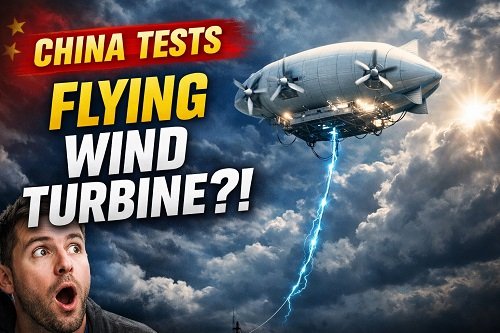
A flying wind turbine is part of a broader idea known as airborne wind energy. Instead of mounting blades on a steel tower, the system is lifted into the sky using an airship-like structure or winged platform.
In this case, the megawatt-class system was developed and tested in China, using a tethered airborne platform that rises thousands of feet above the ground. Wind turbines are built into the flying structure itself.
A strong tether anchors the system to the ground. This tether serves two jobs at once:
● It keeps the turbine stable and controlled
● It sends electricity down to a ground station
No concrete tower. No deep foundations. Just wind, altitude, and a cable.
Why altitude matters so much
The real advantage of this technology is height.
Winds closer to the ground are slower and unpredictable. Trees, buildings, and terrain constantly disturb airflow. But higher up in the atmosphere, wind speeds increase sharply and remain more consistent for longer periods.
At altitudes of 1–2 kilometers:
● Wind flows are smoother
● Energy density is much higher
● Turbines can operate for longer hours each day
This is why even a single airborne system has the potential to match or exceed the output of large ground-based turbines, despite using less material.
What happened during the test?
During the recent test flight, the flying wind turbine successfully:
● Lifted into high-altitude airspace
● Remained stable under controlled conditions
● Generated electricity at a megawatt-class level
● Transmitted power safely to the ground
Most importantly, this was not just a lab demo. The system proved it could produce usable electricity, not just theoretical output.
That step alone separates this test from earlier airborne wind experiments that never moved beyond prototypes.
How this is different from traditional wind turbines
Traditional wind power depends heavily on location. You need strong surface winds, large open land, and expensive infrastructure.
Flying wind turbines change that equation.
Key differences include:
● No permanent towers or massive foundations
● Far less steel and concrete required
● Ability to deploy in remote or difficult terrain
● Access to stronger, more consistent winds
This also means potential use near cities, offshore regions, or places where building tall towers is impractical or restricted.
The big advantages
The excitement around this test isn’t hype. There are real advantages if the technology scales well.
Major benefits include:
● Higher energy output per unit
● Lower material and installation costs
● Faster deployment compared to traditional turbines
● Reduced land use and visual footprint
If commercialized, airborne wind systems could complement solar and conventional wind, especially in regions with unreliable surface winds.
The challenges still ahead
Despite the milestone, this technology is not ready to replace existing wind farms just yet.
Several hurdles remain:
● Airspace regulation: Flying turbines must coexist with aircraft routes
● Weather risks: Storms and extreme turbulence pose safety concerns
● Maintenance: Servicing equipment in the sky is complex
● Costs: Early systems are expensive until mass production begins
These are serious challenges, but none are considered unsolvable by engineers working in the field.
Why this test matters globally
This successful megawatt-class test changes the conversation around renewable energy. It shows that airborne wind power is no longer just an idea discussed in research papers.
It is now a working system producing real electricity.
For countries struggling with land shortages, uneven wind patterns, or rising energy demand, flying wind turbines offer a new path forward. Not a replacement, but a powerful addition to the clean energy mix.
The bottom line
The world’s first megawatt-class flying wind turbine test is a genuine breakthrough. It proves that harvesting energy from high-altitude winds is not science fiction anymore.
If future tests continue to succeed, the sky itself could become a new power plant—quietly spinning above us, turning wind into electricity in ways we never thought practical before.
And that’s a future worth watching.