The conflict involving Iran and rising tensions in the Middle East have once again drawn global attention. Whenever instability occurs in this region, the impact is felt far beyond the battlefield—especially in countries that depend heavily on imported oil. India is one of them.
India is the world’s third-largest consumer of crude oil and imports more than 85–90% of its oil needs from other countries. Because of this dependence, any disruption in global oil supply can quickly affect India’s economy, inflation, and fuel prices.
The current conflict has already caused volatility in oil markets and raised concerns about global energy supply. If the situation escalates further, India could face higher fuel costs, trade disruptions, and economic pressure.
This article explains how the Iran conflict could affect India’s fuel prices, economy, and everyday life.
Understanding the Iran Conflict
The recent escalation began after military actions involving Iran and its regional rivals, including strikes and retaliatory attacks in the Middle East. These events increased geopolitical tension in the region and raised fears of a wider conflict.
One of the biggest concerns is the potential disruption of oil shipments from the Persian Gulf. The region contains several of the world’s largest oil-producing countries, including Saudi Arabia, Iraq, and Iran.
The situation has become even more serious because the Strait of Hormuz—a narrow waterway connecting the Persian Gulf to global shipping routes—plays a central role in the global oil trade. If this route is blocked or disrupted, the supply of oil to many countries could be affected.
Recent reports indicate that the conflict has already disrupted energy supplies and raised fears of a major oil shock in global markets.
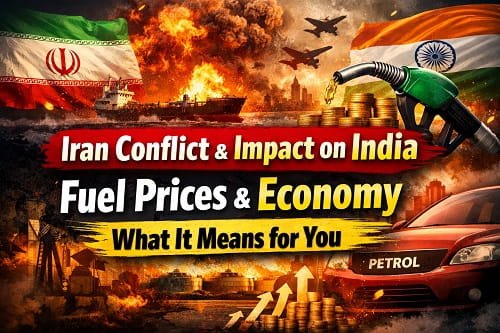
Why the Middle East Is Important for India
India’s strong economic growth requires huge amounts of energy. However, domestic oil production is limited, which means the country must import most of its fuel from abroad.
More than half of India’s crude oil imports pass through the Strait of Hormuz. Any disruption in this shipping route could directly affect India’s oil supply.
India currently imports millions of barrels of oil every day from countries such as Iraq, Saudi Arabia, and the United Arab Emirates. Because these suppliers are located in the Middle East, geopolitical tensions in the region immediately create uncertainty for India’s energy security.
Even if the supply is not completely cut off, the fear of disruption can cause oil prices to rise sharply in global markets.
Rising Oil Prices and Fuel Costs
The most immediate effect of the conflict is the increase in crude oil prices.
When wars or tensions occur in oil-producing regions, traders expect supply shortages. This expectation alone can push oil prices higher.
Recent reports suggest that oil prices have already surged due to the conflict and could rise even further if disruptions continue. In extreme scenarios, analysts warn that crude prices could reach very high levels if Gulf exports are blocked.
For India, higher crude prices mean:
- Higher petrol and diesel prices
- Increased LPG cylinder costs
- More expensive transportation
Although petrol and diesel prices may not rise immediately due to government controls, the pressure on fuel prices eventually reaches consumers.
Impact on Inflation and Household Expenses
Higher fuel prices do not affect only vehicles. They influence the cost of almost everything.
Fuel is used to transport goods across the country. When transport costs increase, the price of food, vegetables, clothing, and other essential items also rises.
Energy is also used in manufacturing and agriculture. For example, fertilizers used in farming depend on natural gas and petroleum products.
Experts warn that rising energy costs could increase inflation in India if the conflict continues for a long time.
This means ordinary households could face higher daily expenses.
Effects on Indian Industries
Many Indian industries depend heavily on petroleum products and global supply chains. When oil prices rise, production costs increase.
Industries that could be affected include:
- Aviation and airlines
- Transportation and logistics
- Automobile manufacturing
- Chemicals and plastics
- Paints and construction materials
Higher input costs may reduce profit margins and slow down industrial growth.
Some manufacturing sectors have already reported rising raw material prices due to the conflict and supply disruptions.
Impact on Financial Markets
Global conflicts often create uncertainty in financial markets.
When oil prices rise sharply, investors become cautious. This can lead to volatility in stock markets and currency exchange rates.
Recent reports show that the rise in crude oil prices has already caused pressure on the Indian stock market and weakened the rupee.
A weaker currency also makes imports more expensive, which further increases inflation.
Trade and Supply Chain Disruptions
The Iran conflict is also affecting international trade routes.
Flight cancellations, shipping delays, and airspace closures in the Middle East have slowed down exports and imports in several industries.
India exports goods such as diamonds, textiles, and engineering products to Middle Eastern countries. Disruptions in transport can delay shipments and affect business operations.
Manufacturers that depend on imported raw materials may also face supply shortages.
Possible Impact on Economic Growth
If oil prices remain high for a long period, India’s overall economic growth could slow down.
Higher fuel prices increase the country’s import bill and put pressure on government finances. They also reduce consumer spending because households must spend more on basic necessities.
Some analysts estimate that prolonged energy shocks could slightly reduce India’s GDP growth if oil prices remain elevated for several months.
However, India has some advantages. The country has diversified its oil imports in recent years and built strategic reserves to manage short-term supply disruptions.
What the Government and RBI Are Doing
The Indian government and the Reserve Bank of India closely monitor global oil markets.
Authorities may take several steps to reduce the impact of the crisis, including:
- Using strategic petroleum reserves
- Adjusting fuel taxes
- Stabilizing the rupee through financial interventions
- Diversifying oil imports from different countries
In recent developments, the RBI reportedly intervened in currency markets to stabilize the rupee during oil-related volatility.
These actions can help reduce the immediate shock to the economy.
What It Means for Common People
For ordinary citizens, the effects of the Iran conflict may appear gradually.
Possible impacts include:
- Higher petrol and diesel prices
- More expensive LPG cylinders
- Increased food and transportation costs
- Slight rise in inflation
However, the overall effect depends on how long the conflict continues. If tensions ease quickly, oil prices may stabilize and the economic impact could remain limited.
Conclusion
The Iran conflict highlights how global events can influence everyday life in distant countries like India. Because India relies heavily on imported oil, instability in the Middle East directly affects fuel prices, inflation, and economic stability.
While the government and financial institutions are working to manage the situation, prolonged tensions could create challenges for industries and households alike.
For now, the biggest factor to watch is oil prices. If supply disruptions increase or the conflict spreads further, India’s economy could face stronger pressure in the coming months.