Imagine this. You come in from a late morning jog, turn on the fan and sit down to rest. Little do you know that it is set to the lowest speed, and you have to stand up again to adjust it. You walk to the kitchen island to make yourself juice and get an important call. While your hands remain occupied, the room has begun cooling down, perhaps, a bit too much. You’re stuck now between shivering and dropping everything at hand to readjust the fan speed.
This is exactly the kind of situation that smart fans are designed to tackle. The convenience of use is unparalleled, while the cost savings on energy are massive.
This blog dives deeper into the gains you make on switching from traditional fans to smarter ones. We delve into how these devices work for enhancing comfort as well as the practical features that you ought to consider when shopping for one. Let’s get into it!
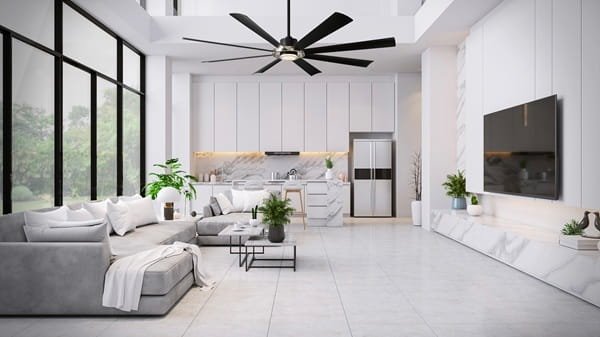
What Smart Ceiling Fans Really Are
The appeal of smart fans lies in their enhanced functionality. They widen the scope of control, increase usage flexibility, and optimise energy consumption. These devices:
- Can be scheduled to turn on or off at pre-set timings
- Can be voice-controlled for convenience
- Allow for app-based control
- Can be optimised for increasing or reducing airflow based on needs
- Help save on long-term electricity bills
For example, the Atomberg Aris Starlight Smart Ceiling Fan operates with low noise and fits effortlessly into your smart home.
| Features | Atomberg Aris Starlight Smart Ceiling Fan |
| Fit for Room Types | Living room, dining room and bedroom |
| Number of Blades | 3 |
| Wattage | 39 Watts |
| Voltage | 165V – 285V |
| Specialties | LED indicators
Remote control Underlight |
| Control Method | IoT |
| Colours Available | Dark Teakwood and Marble White |
Additionally, let’s take a look at how different brands fare so you can get the most out of your preferred smart ceiling fan:
| Parameter | Atomberg | Crompton | Orient |
| Top Features | BLDC motor and inverter-friendly smart operation | Cooling and durability | Premium design features and optimised functionality |
| Energy Efficiency | High energy efficiency | Moderate energy efficiency | Moderate energy efficiency |
| Smart Control | Equipped with smart control features like voice control, remote and app-based control | Comes with smart remote control operations | Equipped with app-based control systems and AI airflow optimisation |
| Noise | Noiseless operation | Largely silent but may operate loudly at higher speeds | Noiseless operation |
| Air Delivery | Consistent air delivery despite voltage fluctuations | Known for air throw and cooling capabilities | Reliable air delivery |
| Cost-Effectiveness | Moderate pricing with high long-term returns | Good price-to-performance ratio | Expensive and focused on buyers who prioritise designs, moderate returns |
| Design Feature | Stylish and minimal designs | Traditional design and aesthetics | Modern and premium design features |
Operational Efficiency with IoT & Automation in Smart Fans
IoT (Internet of Things) and automation features in smart fans make them the advanced devices that they are. Their operational efficiency can be credited to the following:
- Connectivity Options
Smart fans are pre-equipped with IoT, Wi-Fi, and other connectivity technologies to help you control your fan speed remotely. They can be operated from a distance or using mobile apps and physical remote controls.
- BLDC Motors
The star component in smart fans responsible for their operational efficiency is the built-in Brushless DC motors, commonly referred to as BLDC motors. They can provide better airflow while using far less energy than traditional AC motors.
- Customisable Speeds & Modes
IoT and automation-equipped smart fans are designed to adjust fan speed, airflow intensity, and fan modes based on external changes like temperature, humidity, user preference, etc. Personalised experiences are guaranteed through app-based connectivity too.
- LED Indicators
Modern smart ceiling fans come with LED indicators that keep users updated on fan settings. It tracks power status, displays changes in speed, and sends maintenance alerts on the connected app to help prepare for early intervention.
- Hardware Resilience
Put together from sealed electronic components, sturdy downrods, and parts resistant to dust, the hardware resilience in IoT-enabled smart fans is a class apart in terms of durability. It protects the fan from surges after power cuts and other mechanical failures so that you can get the most out of your fans.
Benefits of Smart Ceiling Fans in Homes
In a nutshell, your overall lifestyle experiences an elevation when you trade in your noisy traditional fan and choose to buy smart fans. The benefits can be summed up as:
Convenience in Control
Smart ceiling fans allow for more precision and flexibility in controlling fan speed and functionality. Commands can be changed remotely as long as you remain connected to the Wi-Fi or Bluetooth. You can stand a room away and count on your fan to adjust settings based on your directions through voice detection, too.
Responsible Energy Consumption
Smart fans are sustainable devices that reduce your carbon footprint and help make savings on electricity bills. They can be automated to function at specific speeds during different times of the day or depending on fluctuations in the external temperature. That way, you don’t need to intervene each time to manage energy consumption manually.
Noiseless Comfort
Equipped with the revolutionary BLDC motor, smart fans operate quietly without compromising on energy or operational efficiency. In contrast with traditional ceiling fans that make a humming noise, these devices ensure that your rest isn’t interrupted by harsh sounds. For instance, the Atomberg Aris Contour Smart Ceiling Fan is an automated and IoT-enabled device in this category. It comes with a ring light, is controlled through a remote, and delivers excellent airflow. Moreover, the BLDC motor increases energy efficiency by 65% and promotes long-term savings.
Difference Between Traditional Fans and Smart Fans
| Parameter | Smart Ceiling Fan | Traditional Ceiling Fan |
| Connectivity | Wi-Fi or Bluetooth connectivity for IoT-enabled functionality | No connectivity features |
| Comfort | Can be accessed remotely for convenience | Needs to be manually controlled or adjusted |
| Control | App-based, remote control, voice detectors | Wall switches and manual regulators |
| Automation features | Allows scheduling, customisation of speed, and sensor-based automation | Supports no automation capabilities |
| Energy Efficiency | Uses BLDC motors that increase energy efficiency by 65% | Uses AC motors that require high energy consumption |
| Smart Home Integration | Has integration capabilities to connect with other smart devices | Does not come with integration capabilities |
Conclusion
In a fast-paced world like ours, convenience and technology are buzzwords that no longer remain confined to fancy blue rooms in high-rise buildings and smart workspaces. Automation has entered the personal space and brings with it an array of perks.
For starters, you don’t have to worry about disconnecting a call or abandoning your juice to regulate the fan speed. A quick command to the IoT-enabled smart fan will adjust settings to provide superior comfort while you multitask. Moreover, they don’t even demand as much attention or maintenance as their less modern counterparts.
So if your traditional ceiling fan is wearing out fast and you’re looking for an upgrade, it’s time to give these advanced air delivery devices a chance to shine!