GenAI is no longer a technology that is only found in tech labs or research papers. It has silently made its way into offices, schools, art studios, and even our everyday conversations. A lot of people have used GenAI without being aware of it, for example, through content suggestions, automated customer support, or tools that help in drafting emails and presentations. The thing that sets GenAI apart is not just its ability to automate but to assist, create, and learn together with humans. As this technology is getting more and more available, it is changing the way businesses run, careers develop, and the skills that will be most in demand in the future.
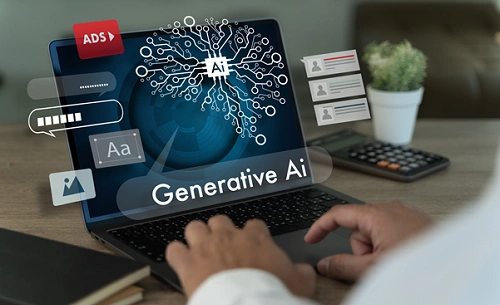
How Businesses Are Adapting to GenAI
Nowadays, companies are continuously bombarded with demands to speed up their operations, tailor customer experiences, and enhance their decision, making capabilities. GenAI is a tool that has been assisting them in accomplishing these very tasks. Far from sidelining employees, it usually behaves as a smart aide that facilitates daily work.
In a marketing office, a small team might have to churn out content for various platforms within a limited time. Previously, that would have implied long working hours and creative exhaustion. However, using GenAI tools, marketers can come up with ideas, polish the message, and change the tone instantly, thus they can dedicate more time to the strategy and creativity aspects.
Across industries, GenAI is being used to
- Improve customer communication through smarter chat support
• Help teams analyze large amounts of information easily
• Support product design and content creation
• Assist decision makers with insights and recommendations
Business leaders are becoming aware that GenAI is most powerful when the employees are aware of the proper usage of the technology. That is why a lot of professionals nowadays are signing up for a generative AI courses to understand how to mix these tools with business activities for greater efficiency instead of considering them separate pieces of software.
The Impact of GenAI on Careers
One of the biggest conversations around GenAI is its impact on jobs. While some fear job loss, many professionals are discovering new opportunities instead. Careers are not disappearing as much as they are evolving.
Consider the example of a graphic designer. Initially, their job entailed designing each visual literally from the ground up. Nowadays, GenAI assists in rapidly coming up with concepts, thereby, the designer is left with more time for polishing the ideas, maintaining brand consistency, and imbuing the work with emotional depth. The job turns into being more of a strategist and a creative rather than a simple technician.
And in the same way, a variety of other professionals in areas such as human resources, finance, education, and sales are discovering that GenAI makes it possible for them to work less with repetitive tasks. Thus, the main emphasis for them shifts to the people, problem, solving, and decision, making.
Careers influenced by GenAI often shift toward
- Strategic thinking rather than manual execution
- Creative direction instead of repetitive production
- Human judgment supported by intelligent tools
- Continuous learning and adaptability
To stay relevant, a lot of professionals are getting a gen ai certification that proves their knowledge of AI tools and its ethical usage. Besides giving them confidence, it also shows that they are ready for the future focused roles.
Skills That Matter in the GenAI Era
With GenAI becoming integrated into daily work, the skills necessary for achievement are altering too. Having technical knowledge is certainly helpful; however, it is not the only thing that is needed. To a large extent, human skills are getting more and more valuable.
For instance, a project manager working with GenAI might use it to get a summary of reports or to draft a plan. But really knowing the team, sorting out disagreements, and deciding the most important things will still be up to the human mind. GenAI is there to help the process but it does not take the place of leadership or empathy.
Key skills gaining importance include
- Critical thinking to evaluate AI generated outputs
- Creativity to guide and refine AI assisted ideas
- Communication to explain and apply insights effectively
- Ethical awareness to ensure responsible AI use
- Learning mindset to adapt as tools evolve
At present, a lot of learning programs center around integrating these contextual human skills with the straightforward AI knowledge. A thoughtfully planned prompt engineering course is not merely a tutorial on tools but also the insight of collaborating with AI in real situations.
GenAI in Everyday Work Life
The impact of GenAI is frequently very invisible. An office worker might still be using it to get a first draft of a presentation outline before a meeting. A school teacher may resort to GenAI to tailor the lesson plans for various learning styles. A founder of a startup company might depend on GenAI to do a preliminary test of new business ideas before actually spending money and human resources on them.
These tiny instances accumulate. And as the result of that, GenAI over time changes the way people think about problems and how they allocate their time. Instead of having nothing but a blank sheet to start with, people in different fields already get some ideas and then work them up. Such a change in work pattern could not only increase one’s self, belief but also make one more willing to take risks.
On the other hand, this implies that completely relying on it can be dangerous. Experts who know the advantages and the drawbacks of GenAI equally become notable. Such a balance is usually the highlight of a gen ai certification program where participants delve into practical situations, ethical issues and the most efficient ways.
The Future of Work With GenAI
Looking ahead, GenAI is likely to become a standard workplace tool rather than a special skill. Much like email or spreadsheets, it will be expected knowledge across roles. What will set professionals apart is how thoughtfully they use it.
Businesses will value people who can
- Ask the right questions to AI systems
- Interpret results with human judgment
- Combine AI insights with business context
- Lead teams through technology driven change
Those who invest in learning early position themselves as adaptable and future ready. Education focused on real world application will play a major role in shaping these careers.
Conclusion
GenAI is transforming enterprises, jobs, and abilities in a manner which is both thrilling and difficult to comprehend.
It’s not a matter of substituting humans but rather of changing the people’s work. Experts that are able to work together with GenAI are more likely to get time for creating, planning, and making significant decisions. One can keep oneself updated and self, assured in an ever, evolving world by acquiring knowledge through a generative ai course or getting a gen ai certification.
Those who perceive GenAI not as a danger but as a potent partner in development and creativity are the ones that will have the future.